
The Evolution of Design: Why Bangalore’s AEC Professionals are Moving from CAD to BIM in 2026
Discover why Bangalore's AEC industry is shifting from CAD to BIM in 2026. Learn the benefits of Revit training and how data-rich modeling is replacing 2D drafting at the best BIM training institute in Bangalore..
Published On : 07 May 2026
In 2026, Bangalore’s skyline is no longer being built on lines and layers; it’s being built on data. As the city pushes forward with massive infrastructure projects like the Blue Line Metro and sustainable smart-city hubs, traditional CAD drafting has officially hit its ceiling.
The Evolution of Design: Why Bangalore’s AEC Professionals are Moving from CAD to BIM in 2026
For AEC (Architecture, Engineering, and Construction) professionals, the transition to Building Information Modeling (BIM) is no longer a career "upgrade"—it is the baseline for survival. At
CAD vs. BIM: The Death of the "Digital Pencil"
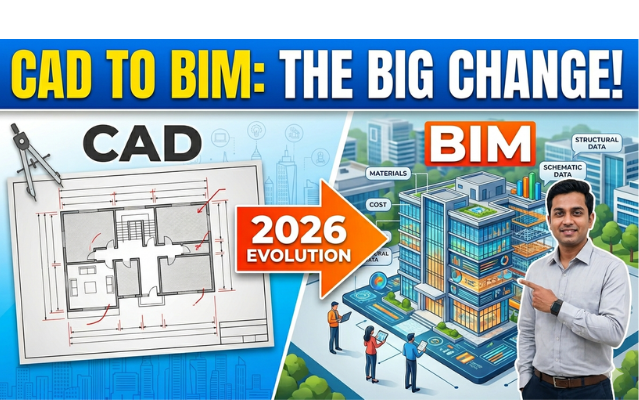
Historically, CAD (Computer-Aided Design) was a digital version of the drawing board. While it provided precision, it lacked intelligence. BIM, powered by software like Revit, has fundamentally changed the AEC sector’s operations.
Why CAD is No Longer Sufficient:
Manual Updates: Changing a window in a CAD floor plan requires manual changes in every section and elevation.
Fragmented Teams: Architects and engineers often work in silos, leading to massive miscommunication.
Zero Data Insight: CAD focuses on geometry but offers no data on material costs, energy performance, or construction timelines.
The BIM Revolution (2026 Standard):
A Unified Model: BIM provides a single source of truth where all stakeholders work on a shared digital model in real-time.
Parametric Intelligence: In a
BIM course in Bangalore , you learn that every element is "smart"—a wall knows its cost, thermal rating, and structural load.Predictive Workflows: 2026 BIM tools use AI to simulate project risks and automate code compliance checks before a single brick is laid.
Top BIM Trends Shaping Bangalore’s Job Market in 2026
If you are looking for
AI-BIM Convergence: Artificial Intelligence is now reshaping AEC workflows. AI is currently capable of generating optimized design options via generative design and automatically detecting clashes before coordination meetings even happen.
Digital Twins & Infrastructure: A BIM model is no longer static. It develops into a "Digital Twin"—a live model that functions post-construction for predictive maintenance. This is crucial for Bangalore’s Metro systems, smart-city infrastructure, and airports.
4D, 5D, and Beyond: The industry has moved beyond 3D. 4D adds scheduling, and 5D adds real-time cost tracking. Mastering these dimensions at a
top BIM institute allows you to manage budgets and timelines with surgical precision.
ROI of Upskilling: Salaries and Global Scope
The financial incentive to switch is clear. In 2026, BIM professionals in India earn significantly more than traditional CAD drafters:
Entry-Level BIM Engineer: ₹4.5L – ₹6L per annum.
Experienced Professionals: Can exceed ₹25L per annum.
Global Mobility: BIM is a globally recognized skill, unlocking high-paying opportunities in the UAE, USA, and UK.
Frequently Asked Questions
What is the main difference between CAD and BIM in 2026?
CAD focuses on 2D/3D drafting of lines and shapes, while BIM creates a data-rich digital prototype. BIM integrates architecture, structure, and MEP data into a single model, enabling real-time collaboration and automated clash detection that CAD cannot provide.
Is learning Revit mandatory for architects in Bangalore?
Yes. By 2026, most top-tier AEC firms in Bangalore require Revit proficiency. It is the industry standard for BIM authoring and is essential for participating in large-scale infrastructure and commercial projects.
How does BIM improve construction efficiency?
BIM improves efficiency by detecting design errors early, reducing material waste, and optimizing construction schedules (4D). It allows teams to simulate the entire building lifecycle, which minimizes costly rework on-site.