
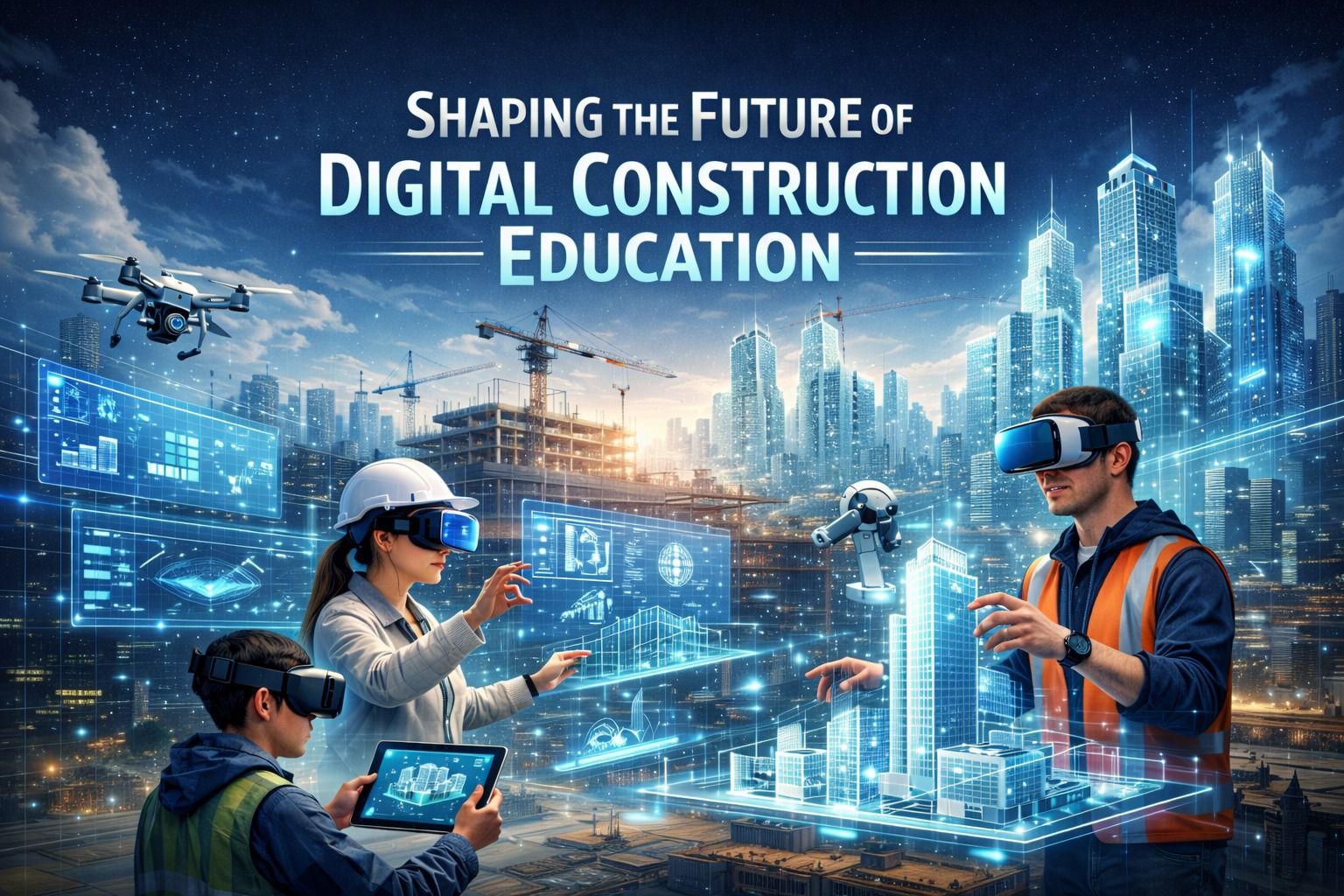
Shaping the Future of Digital Construction Education
A professional landscape poster showcasing the future of digital construction education through virtual reality, BIM models, smart construction sites, and advanced learning technologies, highlighting innovation in engineering and construction training..
Published On : 20 Jan 2026
In the world of modern construction, where accuracy, coordination, and smart decision-making matter
more than ever, Building Information Modelling (BIM) has emerged as the heartbeat of the industry.
Today, engineers, architects, and construction professionals need more than textbook knowledge —
they need hands-on digital skills that match global standards.
This is exactly where HPS BIM Institute stands out.
Recognized as one of Bangalore’s dedicated BIM-focused training centres, HPS BIM Institute has
built a strong reputation for delivering high-quality, practical, and industry-driven education. The
institute focuses on empowering civil, structural, and mechanical engineers with real-world BIM
capabilities to make them job-ready for India and international markets.
The training approach at HPS BIM Institute blends software mastery, live project exposure,
practical workflows, and placement assistance, ensuring every learner gains the confidence to work
in real construction environments. Their curriculum is designed by industry professionals with years
of global BIM experience, making the training both relevant and future-oriented.
Courses Offered at HPS BIM Institute
Below is a detailed overview of the key programs offered at
the institute, each structured to build strong technical and practical
foundations.
1. BIM Professional Basic Course for Civil Engineers
This course introduces students to the world of BIM by
covering the essential principles of digital construction. Learners gain a
solid understanding of how BIM is used in planning, designing, and coordinating
civil engineering projects.
The training includes detailed practice on major software like
Revit Architecture, Revit Structure, Revit MEP, AutoCAD, and Navisworks. Students learn to create
intelligent 3D models, prepare architectural and structural layouts, perform
basic clash checks, and understand how BIM supports design and documentation.
This course is ideal for students or beginners who want to
build a strong foundation and confidently step into BIM workflows.
2. BIM Professional Advanced Course for Civil Engineers
This program
is designed for learners who want to progress beyond the basics and master
advanced BIM workflows used by global AEC (Architecture, Engineering &
Construction) companies.
The course focuses heavily on interdisciplinary coordination, clash detection, and model
validation. Students learn how civil, structural, and architectural models
work together in complex projects. The training includes detailed hands-on work
with Revit, Navisworks Manage, AutoCAD,
and advanced BIM collaboration methods.
The curriculum covers advanced topics like:
●
Creating coordinated BIM project sets
●
Model auditing and quality checks
●
Quantity extraction from BIM
●
4D (time-based) and 5D (cost-based) simulation
concepts
By the end of this course, learners become capable of
handling BIM execution tasks and assisting BIM Coordinators and Managers.
3. Oil & Gas / Piping Professional Course for Mechanical Engineers
A specialized program crafted for mechanical engineers
aiming to build expertise in industrial projects, especially in the oil & gas, refineries, and process
plant sectors.
The course focuses on developing strong skills in:
●
Piping design and modeling
●
Equipment layout
●
Isometric drawing creation
●
Understanding industrial standards and safety
norms
●
BIM-based coordination in mechanical and piping
systems
Students learn how piping systems are designed, analyzed,
and integrated into larger plant structures using modern digital tools and BIM
workflows. This program opens pathways to high-demand global engineering roles.
4. Structural Design Course for Structural Engineers
Focused on preparing structural engineers for real-time
design and BIM-integrated environments, this course combines both structural
analysis and BIM-centric modeling.
The course covers:
●
Building and foundation modeling
●
Load analysis including seismic, wind, and live
loads
●
Structural detailing concepts
●
Integration of structural models with
architectural and MEP designs
Learners work extensively with tools like ETABS, SAFE, and STAAD.Pro,
along with BIM-based coordination principles. This ensures engineers not only
design strong structural systems but also understand how these designs fit into
complete BIM projects.
Why Students Choose HPS BIM Institute
Practical, Industry-Based Training
Every topic is taught with real-project examples, ensuring
learners understand how BIM is used on actual construction sites.
Global-Standard Software Training
Students gain mastery in widely used tools like Revit,
Navisworks, AutoCAD, ETABS, SAFE, STAAD.Pro, and more.
Portfolio-Building Live Projects
The institute provides live project tasks that help students
build a professional portfolio required by recruiters.
Experienced Faculties
The trainers are industry professionals with hands-on BIM
and engineering experience.
Placement Assistance
From resume building to
interview preparation, the institute supports learners until they secure a job.
Conclusion
HPS BIM Institute is more than just a training centre — it
is a career transformation platform for engineers who want to thrive in the
digital construction era. Their structured courses, practical learning
environment, and commitment to student success make them one of the most
reliable institutes for BIM education in Bangalore.